02 — BPN · Main project
Battery Passport Network
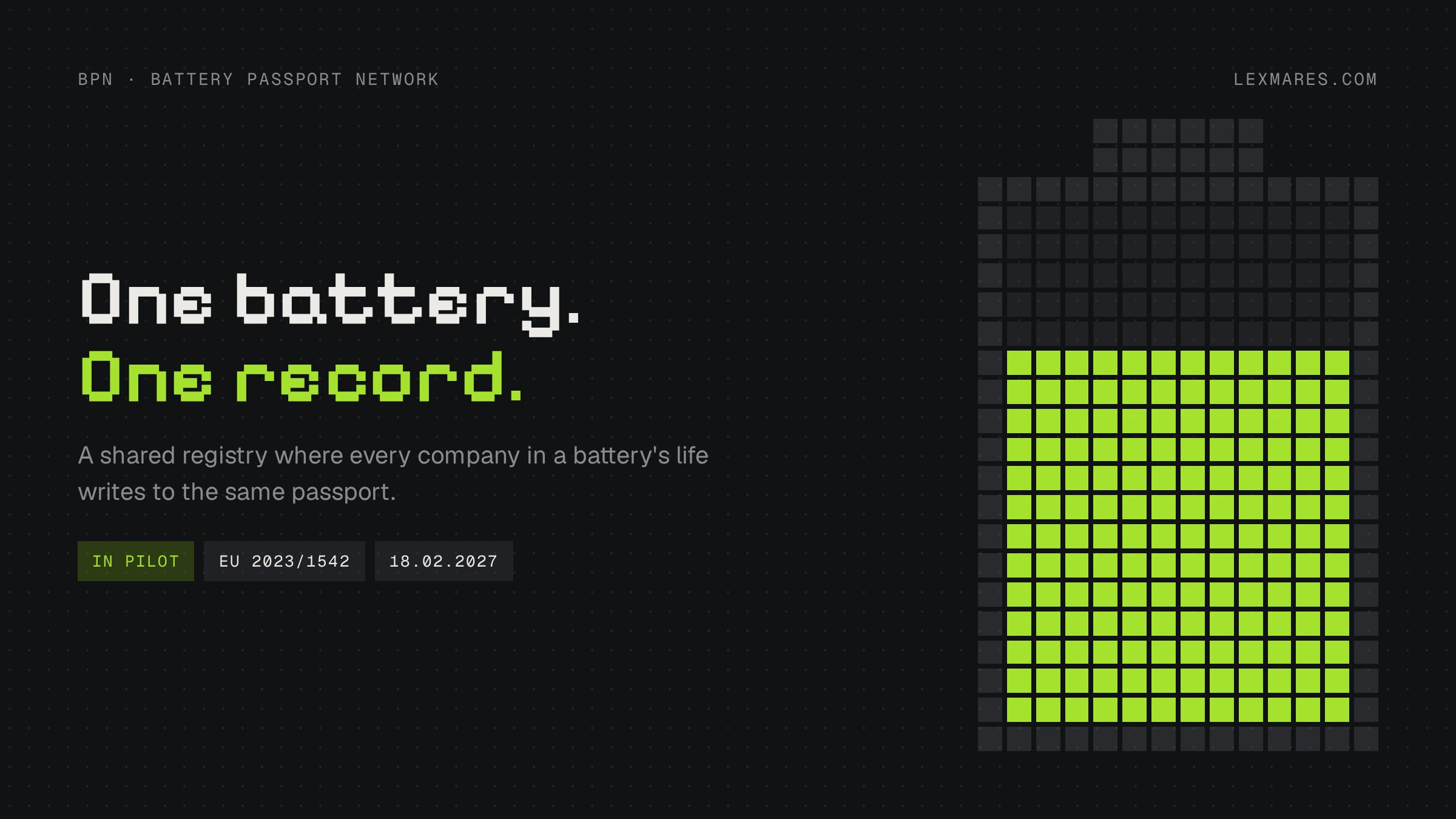
A shared registry for EU battery passports. Every battery gets one record, and every company that touches the battery writes to that same record.
- In pilot · demo on request
- Regulation (EU) 2023/1542
- Mandatory 18.02.2027
01
One battery. One record.
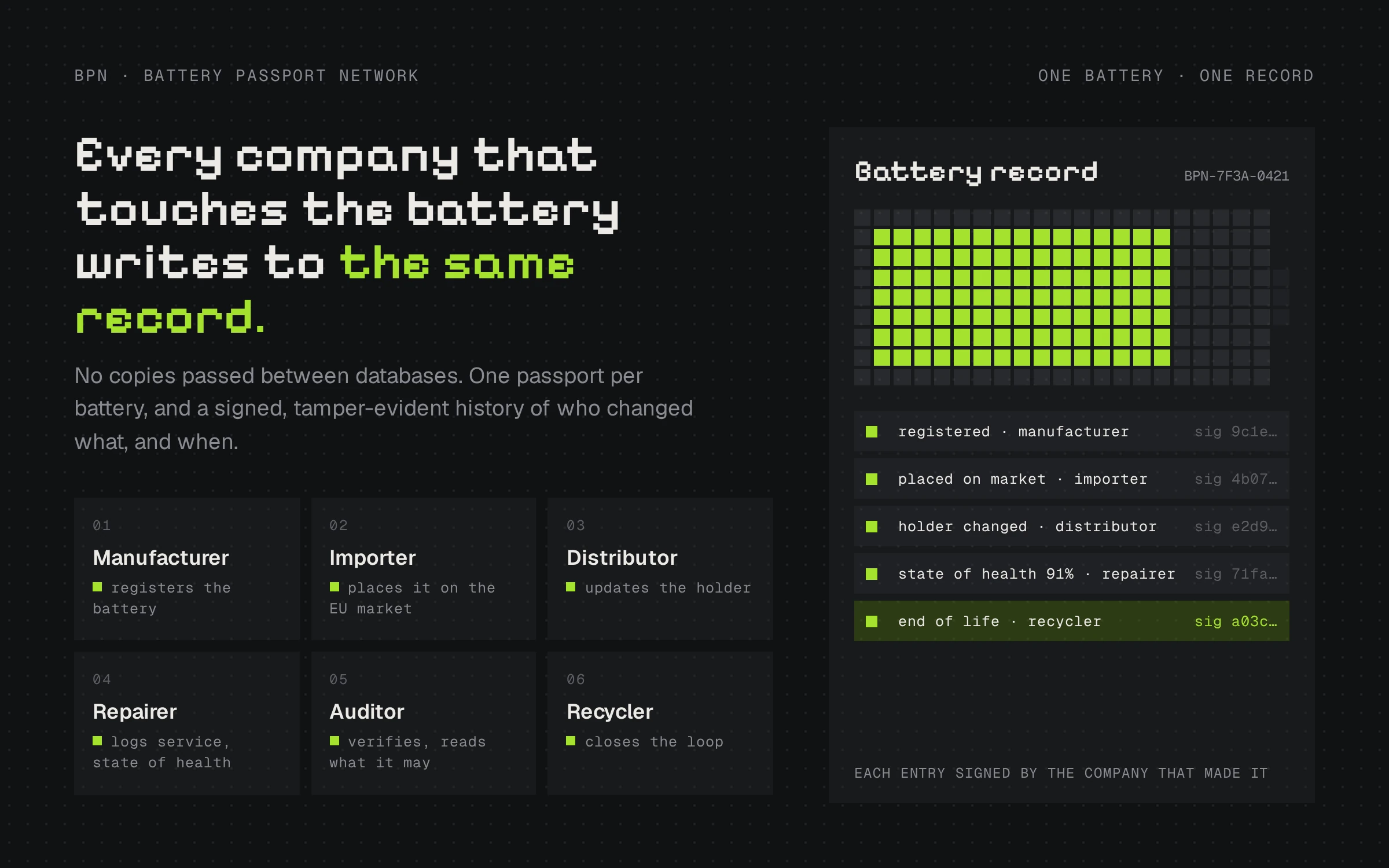
A battery changes hands many times. It is made, imported, sold, installed, repaired, sometimes given a second life, and finally recycled. In most setups every company along the way keeps its own copy of the facts, and the copies drift apart.
BPN is a registry. Each battery has exactly one record. The manufacturer creates it, and everyone who touches the battery after that (importer, distributor, repairer, auditor, recycler) writes to the same record.
Every entry is signed by the organisation that made it. Nothing is quietly overwritten: a correction is a new entry, so the history is tamper-evident from the first day to the last.
02
Every field decides who can see it.
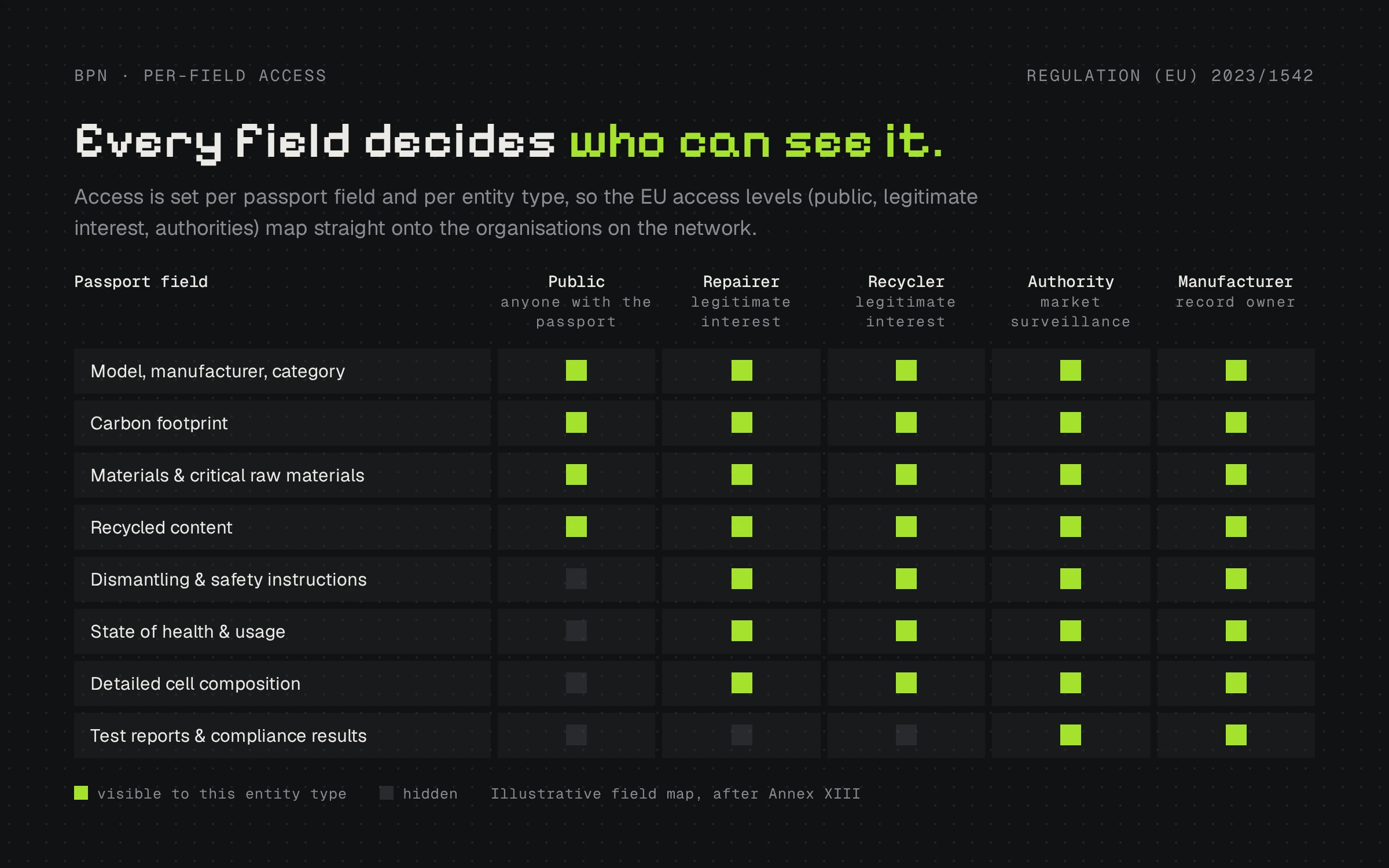
The regulation doesn't split passport data into public and private. It defines audiences: some information is open to everyone, some only to persons with a legitimate interest, such as repairers, second-life operators and recyclers, and some only to authorities.
BPN models this per field. Every field of the passport carries its own read and write rules for each entity type on the network: manufacturer, importer, distributor, service provider, recycler, authority.
Same record, different views. A buyer sees the public fields. A recycler also sees dismantling and safety information. A market surveillance authority sees the compliance results.
03
18 February 2027.
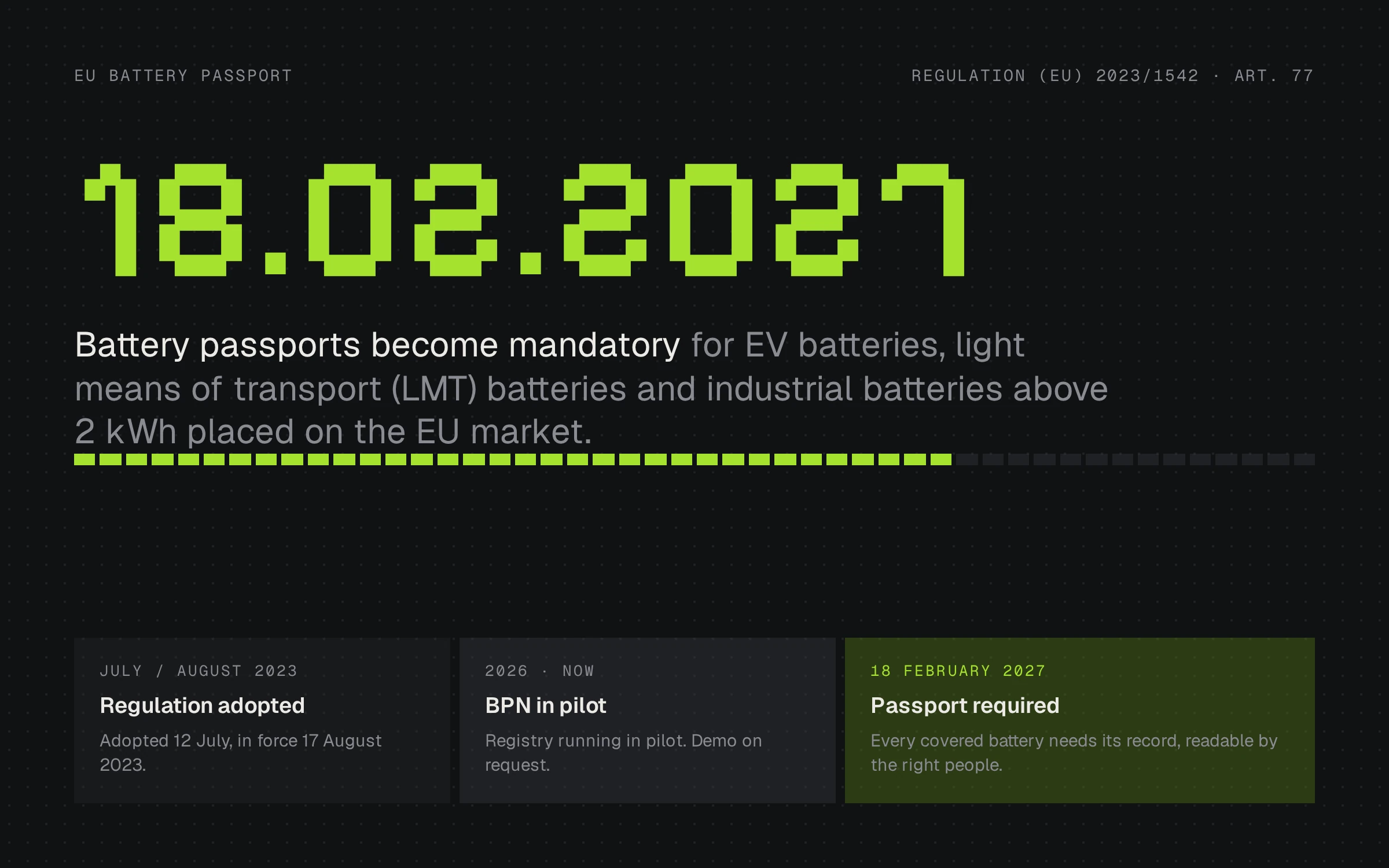
Regulation (EU) 2023/1542, the EU Battery Regulation, makes the battery passport mandatory from 18 February 2027 for electric vehicle batteries, light means of transport (LMT) batteries and industrial batteries above 2 kWh placed on the EU market.
Each of those batteries needs a passport reachable through a QR code, with information that stays current for the battery's whole life, and readable by the right people at the right level.
04
Under the hood
Permissioned shared ledger
Hyperledger Fabric 2.5. Only approved organisations join, each identified by its own certificate.
Go chaincode
Enforces the battery schema, the per-field access rules and which entity type may make which change.
Configured, not hard-coded
Battery types and their fields are configuration on the network, so the passport can follow the rules as they are finalised.
Gateway API
Sessions, API keys and certificate sign-in by signing a one-time challenge. Private keys are never stored.
Next.js dashboard
An operator console for the network, and a portal where economic operators register and update batteries.
05
The first use case of CORA
BPN runs on CORA, Certified Origin & Record Assurance: traceability for anything whose history matters.
Batteries come first because the law makes them urgent. The same pattern (one shared record, signed entries, per-field access) fits any product where several companies need to trust one history.
06
Honest status
BPN is in pilot. It is not publicly deployed yet.
The registry, chaincode, gateway and dashboard run in the pilot environment, and I can walk you through them live.
Questions people ask
- When is the EU battery passport mandatory?
- From 18 February 2027, under Article 77 of Regulation (EU) 2023/1542.
- Which batteries need a battery passport?
- Electric vehicle batteries, light means of transport (LMT) batteries and industrial batteries with a capacity above 2 kWh placed on the EU market or put into service.
- Who can see battery passport data?
- It depends on the field. Some information is public, some is for persons with a legitimate interest such as repairers and recyclers, and some is only for authorities. BPN sets access per field and per entity type to match.
- Is BPN live?
- BPN is in pilot and not publicly deployed yet. Demos are available on request.
See BPN before the deadline.
If your company puts batteries on the EU market, ask for a demo and see how your battery records would work on BPN before the deadline.